
Romania 2026
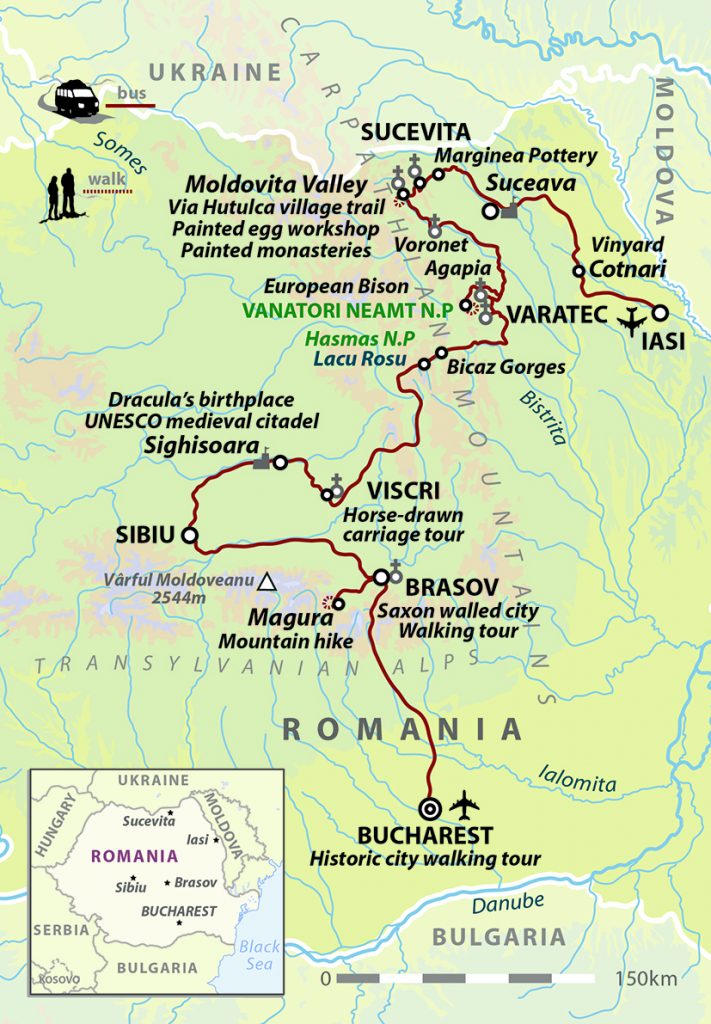
In May 2026 we had a holiday touring round Romania. Starting in the north in Iasi (pronounced “Yash”) we covered the three main Historical regions of the country: Moldavia, Transylvania and Wallachia. We combined treks in some stunning countryside with (brief) visits to several old cities. Over the course of the trip we got to know a lot about the changing fortunes of the country throughout the centuries. The Austro-Hungarians, the Germans and the Tatars all settled and left their mark on the country. So did the Communists after WWII, particularly in the brutal architecture of the larger cities.
I found Romania a surprisingly religious country. Not only were there an enormous number of old and well preserved churches, but they have large numbers of devout worshippers across all the generations. A number of complex reasons gives rise to this, including: in the “olden days” the tendency for princes to dedicate churches every time they went into battle (which was frequent)to religion being a counter to the unpopular strictures of the communist years. As an amusing example there are several old churches in Bucharest that stood in the way of communist redevelopment plans. If demolishing them was likely to cause too much popular protest, the authorities, rather than changing their building plans, pragmatically and simply moved the churches in their entirety on rollers to a different location.
We went in a small group with the holiday company, Wild Frontiers, whose itinerary covered a lot of the country. Unfortunately this meant that we were packing & unpacking on a daily basis most of the time. A bit tedious – but we did have a great variety of experiences and saw a great deal.
The first full day of the holiday coincided with Eleanor’s latest Back-Yard-ultra race (basically an endurance race round a circuit until there is only one runner remaining). Needless to say with live feeds of the race, we managed to get others on the group hooked into following her progress. Eleanor eventually finished on the Sunday, clocking up a creditable 145 miles – but not beating her PB(!?!).
We started off in the north of the country in the Moldavia region. After a brief stroll down the main, mostly pedestrianised, avenue of Iasi, we were whisked off to stay in a charming wooden house in Sucevita, but not before visiting a large winery (not heard of Romanian wine? – sorry, but I stuck to beer for the rest of the trip!) and the remains of a fortress in Suceava (a bit underwhelming). The following day we had the first of our three gentle hikes in the Carpathians, along the Via Hutulca. The highly decorated Voronet monastery and the enclosed Agapia Monastery in a nuns’ village were unusual and very photogenic. Chuck in the Popa House (Peasant’s Museum) and a demonstration of traditional egg-painting (yes we bought one)to round off a very varied set of sites in this Northern region of Romania.
We next travelled through Transylvania with its many German connections. We had an overnight stop in Viscri sleeping in a very basic old Saxon wooden farmhouse and were a few doors up the road from where King Charles III bought and converted a similar couple of cottages. I believe that he has long been into eco-tourism and preserving local crafts and life-styles. We had relatively brief stays in three Transylvanian towns: Sighisoara, Sibiu and Brasov. Each of these towns deserved a longer stay and exploration. We even saw the house where Vlad Dracul (The Impaler) was born; he who, thanks to Bram Stoker, was re-envisaged as the the vampire Dracula. It shows the power of a good story and the follow-up marketing that Bran Castle (with only tenuous links to Vlad Dracul) is now the top tourist site in Romania.
The southern most region of Romania, Wallachia, was our final stop. A tour of the capital Bucharest was unfortunately cut short due to the airline cancelling the group’s return flight and changing us to an earlier flight.